Archive
The value of protest – posted 9/26/2025
I saw that there will be new No Kings demonstrations across the country on Saturday, October 18. Concord will again be a site, this time for No Kings 2. The anti-Trump Concord rallies held this year in April, June, and on Labor Day in September have surpassed all my expectations. I have lived in New Hampshire for over 40 years and these were some of the best-attended demonstrations I have witnessed.
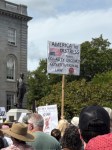
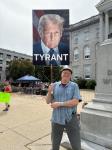
What was great about the demonstrations besides the turnout was the positive energy unleashed and the creativity of the many signs. The signs were personal, funny, politically savvy and artistic. The demonstrations were very encouraging because they showed how many New Hampshire people are utterly opposed to any slide into fascism. People in large numbers don’t want to lose our democracy.
I have to say that in observing the demonstrations I have a sense of deja vu. The movement against the Trump regime is reminiscent of the movement against the Richard Nixon presidency. In both situations, the nation faced an out-of-control President attempting to hoard power and use the power of the State to repress opponents. Like now, the leadership of the Democratic Party was weak and feckless. Progressive Democrats and independent radicals had little influence in Congress. We took it to the streets. Between 1968-1973, there were innumerable demonstrations against the Nixon regime and the Vietnam War.
Just as happened with Nixon, I would argue that a mass movement could hasten the end of the Trump regime. The movement against Nixon was central to creating the circumstances for his resignation from the presidency.
The street demonstrations in the 1960’s began before the Nixon presidency. Both the civil rights movement and the anti-war movement showed the power of non-violent protest. The great civil rights March on Washington in 1963 was followed by the first anti-Vietnam War March on Washington in April 1965. Then there was the October 1967 March on the Pentagon, the Washington Moratorium of 1969 (the largest demonstration in U.S. history at that time), the demonstrations around the shootings at Kent State and Jackson State in 1970 and the May Day protests in May 1971.
The demonstrations had started small and they built dramatically. By the time of the Nixon presidency, the Movement had gained tremendous force. Organizing can build identity and self-confidence in the movement. In my college in Connecticut, we shut down the campus in the aftermath of Kent State and spent weeks organizing. Similar things happened on many campuses.
There were always people who questioned the value of protest. That sentiment has a familiar ring. Since the Vietnam era, the view that demonstrations don’t accomplish anything has been common. That viewpoint typically dismisses protests as, at best, feel-good exercises that don’t change anything. They run the risk of degenerating into violence with the possibility of alienating broader swaths of the public.
Sometimes those opposed to protest will highlight the importance of electoral politics as the means to defeat Trump and MAGA. And there is little doubt the 2026 and 2028 elections are very important as a way to push back.
The Trump behemoth has proven to be formidable. They control all three branches of government. They have been flooding the zone trying to create the impression of strength and invincibility. They have moved quickly and they aim to make opposition feel hopeless and overwhelmed.
While the effect of protest has been hotly debated, there is more evidence available now that shows how crucial the Movement was in weakening Nixon and the same dynamic can play out with Trump. Although he publicly dismissed protesters, Nixon felt threatened by the scope of dissent and protest. Even today, people don’t realize the power the Movement had then.
Nixon’s plan to end the Vietnam War was actually a plan for massive escalation. He floated the idea of using nuclear weapons to pressure concessions from the North Vietnamese. He also discussed mining North Vietnamese harbors. He had a “madman theory” designed to show the North Vietnamese, the NLF and the Russians that he was unpredictable and capable of massive destruction if they did not agree to his peace terms. Bluff was a big part of Nixon’s game plan.
The fact that the American people in massive numbers wanted withdrawal from the war was a critical deterrent to Nixon’s plan of escalation. It led to Nixon’s policy of Vietnamization, replacing and removing U.S. soldiers from the battlefield. It acted as a stop to the use of any nuclear weapon. Nixon and Henry Kissinger worried about domestic political blowback. It also led to an end to the military draft in 1973.
Nixon was constantly scheming and calculating but there can be little doubt that the size of his opposition inhibited him. Both Daniel Ellsberg and Admiral Thomas Moorer, Chairman of the Joint Chiefs, have written that the Movement restrained decision makers from worse excesses. It is also possible that Nixon’s preoccupation with protesters (like Ellsberg) fed his paranoia and led him to authorize crimes that resulted in his downfall.
To its credit, the bulk of the Nixon opposition stayed unified as evidenced by the repeated massive anti-war demonstrations. There were dopey infantile extremists like the Weathermen but they were a tiny fringe.The example of masses of people organizing together speaks directly to our time. The American people are in the process of building an enormous opposition to MAGA fascism to preserve democracy. Resistance will build more resistance as we broaden our coalition.
The Trump regime can be brought down just as happened to Nixon’s regime. Trump and MAGA have massively over-reached and they are awakening a sleeping giant. The Jimmy Kimmel return is a perfect example of how to fight back. Fascism is not inevitable and no one knows what will happen next. Our protests need to keep building and expanding.
The courage of Robert Smalls – posted 9/21/2025
Last fall, when I was traveling in South Carolina, my friend Robin, who is a civil rights attorney, told me about Robert Smalls and showed me a plaque in his honor in Charleston. I have to admit I had barely heard of him. In all my years of education and in my own independent reading, his name was never mentioned.
Smalls grew up in Beaufort, South Carolina. He was born a slave in 1839. His situation was unusual. His owners, the McKee family, made him what was called a ‘quasi-slave’. He was raised as if he was a rich white boy even though he could be beaten or sold off at any time. The McKee family treated Robert almost like a son.
As a young man, Robert asked to buy his freedom but the McKees did not respond well. They tried to break Robert’s spirit by exposing him to slavery’s dark side but that backfired. Robert’s mother and Henry McKee, the son of the patriarch, decided on a different plan to address Robert’s rebellious tendencies. McKee rented him out for work in Charleston, a plan that profited McKee who kept nine-tenths of the money earned.
That led to Robert working a variety of jobs as a laborer. One job was as a dockworker and then a sailor for the Confederate Navy. The Civil War was already underway. Robert was hired for the lowest position on a ship as a deckhand but he was a quick study and soon rose to become one of the top ranked black sailors on his ship, the C.S.S. Planter. He got trained as a helmsman.
In that role, he became an expert on the ins and outs of Charleston harbor. The Captain of the Planter taught Robert everything he needed to know about running a boat. Robert also knew the location of all the mines placed in the harbor that were meant to blow up Union ships as he was one of those responsible for placing the mines.
Charleston had played a critical role as the most active North American port in the slave trade. Nearly half the captives forced from Africa to the mainland United States arrived through Charleston. By 1860, an estimated 4 million people were being held in bondage.
During those years around the start of the Civil War, Smalls got married and he went to his wife’s owner to see if he could purchase her freedom. The price was $800, which was an almost impossible sum for someone in Smalls’ position. The financial impossibility of buying his wife’s freedom (along with the possibility that his wife could conceivably be sold along with his two small children) led Smalls to think more seriously about escape.
Smalls hatched a plan. Over a period of months he waited for the right time. He needed the Captain and the other white members of the crew to be off the ship (which was not supposed to happen). The opportunity arose on May 13, 1862. Smalls and a small crew of black sailors slipped their cotton steamer off the dock in the middle of the night. They picked up family members at a rendez-vous spot and then they carefully navigated through Charleston harbor.
Smalls even got the Captain’s broad-rimmed hat to wear which would be recognized by those defending the harbor. He counted on the dark to aid his ruse. If the Confederates realized it was a ship commandeered by slaves, all on board would have very likely been tortured and executed. It was no easy feat to get through the heavily fortified harbor. Smalls had to ring a secret bell code and navigate through five check points. The Union Navy had blockaded Confederate ports including Charleston and Smalls hoped to reach the Union ships that were outside the harbor.
When the Union officers saw the Planter, they almost fired on it. If hit, the ship would have been a powder keg since it was heavily armed. There was 200 rounds of ammunition, four cannons, a 32 pound pivot gun, a 24-pound howitzer and 4 other guns on board. However, Smalls displayed a white flag and that saved the day. The Confederates realized what was happening too late. They fired on the Planter but the ship was out of range. Smalls’ escape meant an unexpected weapons bonanza for the Union. It was the largest seizure of weapons in the entire war.
The news of the escape to freedom went viral nationally. Smalls became an instant hero. The U.S. Congress passed a private bill authorizing the Navy to appraise the value of the Planter and they awarded Smalls and his crew a monetary award. Smalls received $1500, a significant sum in those days. It was enough to allow him to purchase his former owner’s house after the war. The Confederacy was so freaked out by Smalls’ audacity, they put a $4000 bounty on his head.
President Lincoln was extremely impressed by Smalls’ actions. He invited him to meet at the White House. Smalls had been lobbying Edwin Stanton, the Secretary of War, to begin enlisting Black soldiers. Lincoln subsequently made that hugely consequential decision which dramatically advanced the Union’s cause. It is likely that Smalls’ exemplary action persuaded Lincoln to make that decision.
It is hard to overstate the importance of the introduction of Black troops to the Union side. The effect was tide-changing. Nearly 200,000 Black men, many previously enslaved, served in the Union Army and Navy. The new troop addition gave the Union a crucial manpower advantage while depleting the Confederate labor force. It also transformed the entire goal of the civil war. The war became not just about preserving the Union. It became a war of liberation from slavery. The introduction of Black troops was a devastating psychological blow to the already battered Confederacy.
Smalls fought on the Union side in 17 military actions and became the first African American Captain in the United States Navy. He personally shattered any notion of Black inferiority and inspired millions. He had immense popularity after the war and he served in the South Carolina assembly and then served five terms in the U.S. House of Representatives. He was a founding member of the South Carolina Republican Party. In 1895 he fought tooth and nail against Jim Crow in the South Carolina Constitutional Convention that stripped Black people of their voting rights again.
In Smalls’ lifetime, Black people had already been excluded from democracy for 200 years. He said:
“My race needs no special defense for the past history of them and this country. It proves them to be equal of any people anywhere. All they need is an equal chance in the battle of life.”
Smalls’ story has never reached a large mass audience even though his actions sent a huge shock wave across the country during the Civil War. He may be the least well-known individual whose actions had the most consequential effect on the entire Civil War.
The Supreme Court abandons the Fourth Amendment – posted 9/14/2025
For the U.S. Supreme Court majority, poor quality decisions are the new normal. They draft edicts on major issues – not opinions. Such is the case with their new shadow docket decision on racial profiling. They give the okay to racial profiling, a practice previously considered unconstitutional and they don’t bother to explain their reasons. It is not clear how such an edict can, in any way, be precedential.
In the case of Noem v Vasquez Perdomo, the Court ruled to halt a lower court order that had found certain criteria used by federal immigration agents conducting raids violated the Fourth Amendment. That foundational amendment protects all persons (not just citizens) against search and seizures without reasonable suspicion. Reasonable suspicion has typically required specific individualized articulable facts.
The lower court had prohibited ICE agents in California from stopping or arresting based on four factors: apparent ethnicity; whether they spoke Spanish or had an accent; whether they were in a certain location where immigrants may gather; or if they worked a job considered common to undocumented immigrants.
Now the Supreme Court majority offers a free pass on racially profiling Latinos. They are allowing unidentified men in masks with guns to stop Latinos based on the fact they are Latino. Nothing could be more antithetical to the Fourth Amendment requirement that there be some individualized basis for a stop beyond how you look or talk.
This is the same court that explicitly said race could never be considered in college admissions but, in this circumstance, it is fine. They failed to comment on the fact they just said race can’t be considered across-the-board in voting rights and education. As noted, the Court majority didn’t explain their reasoning. The Supreme Court has demonstrated an increasing tendency to make important rulings with no reasoning or explanation. They appear to have forgotten that their legitimacy depends on the quality of the explanation they offer when deciding.
The Ninth Circuit Court of Appeals had unanimously affirmed the District Court decision in Vasquez Perdomo with detailed reasoning. The Supreme Court gave no deference to those opinions. While their order is not a final decision on the merits it doesn’t bode well for any final decision. It is hard to imagine they would have issued their order if there were not six votes supporting racial profiling.
The only thing offered by the Court majority is a concurrence signed only by Brett Kavanaugh. Maybe he wrote it because the Court has received so much flak about the shadow docket. Justice Kavanaugh wrote:
“The Government sometimes makes brief investigative stops to check the immigration status of those who gather in locations where people are hired for day jobs, who work or appear to work in jobs such as construction, landscaping, agriculture or car washes that often do not require paperwork and are therefore attractive to illegal immigrants, and who do not speak much if any English. If the officers learn that the individual they stopped is a U.S. citizen or otherwise lawfully in the United States, they promptly let the individual go.”
Reading that, I did wonder about the out-of -touch world Kavanaugh inhabits. His wealthy, preppy, country club roots were showing. Some of the plaintiffs in this case were U.S. citizens. Some of their stops have been violent and they have not been promptly let go. People have been detained for extended periods. Kavanaugh is in an ivory tower, divorced from reality.
There was an extensive record from the lower federal court showing both the violence of ICE and the fact that Latino-looking U.S. citizens have been wrongly held and detained for far more than “brief” stops but Kavanaugh overlooked the fact-finding. The truth is that people who have attempted to show ICE agents proof of citizenship have been getting harassed and detained. Only in Kavanaugh’s mind are they promptly let go. The reality is an authoritarian goon squad manhandling and brutalizing people and flying them to faraway places.
Justice Sonia Sotomayor, along with Justices Kagan and Jackson, disagreed vehemently with the Vasquez Perdomo majority. Justice Sotomayor wrote:
“We should not have to live in a country where the Government can seize anyone who looks Latino, speaks Spanish and appears to work a low wage job. Rather than stand idly by while our constitutional freedoms are lost, I dissent.”
What has become common is large roving patrols of unidentified, masked federal agents dressed in SWAT clothing, heavily armed with weapons displayed, swarming people of color and taking them to places unknown and not easily traceable. I would submit this is not the practice of a democratic society. Being stopped for looking Latino or speaking Spanish doesn’t square with the Fourth Amendment requirement that a police stop requires specific articulable facts.
This is too reminiscent of the practice of authoritarian societies. In 1930’s Germany, Jews were required to carry papers and wear a yellow star that identified them as Jewish. Now, in America, many Latinos are afraid to go outside unless they carry their immigration papers. Being able to move freely without government interference is part of what separates a free society from a police state.
The Trump regime is engaged in an unprecedented power grab. The Supreme Court majority is failing the American public by facilitating that power grab. They almost always give Trump his way no matter how outrageous the case. Instead of putting life into our Fourth Amendment, they are bleeding it while green lighting a racist practice.
This is another shameful moment for the Supreme Court. The Noem v Vasquez Perdomo decision hasn’t gotten the publicity it deserves. It is in the disgraceful tradition of worst Supreme Court decisions like Dred Scott, Korematsu and the Trump immunity decision.
When malevolence replaces due process – posted 9/7/2025
The nasty underside of the Trump immigration agenda keeps gaining visibility. Deporting as many as possible as quickly as possible while disappearing due process is the name of the game. Smearing and demonizing those who are caught in the ICE machinery is also part of the game plan. The Trump regime always say they are deporting “the worst of the worst” but that is a big lie. The deported could be your co-workers, a graduate student or some unlucky person with a brown skin.
While Americans have been told these mass deportations will make America great, I would submit the erosion of due process is a grave danger for all of our rights. Taking away rights from a disfavored group creates precedent for taking away rights from everyone else.
With so many court decisions playing out, it can be difficult to sort out which ones are most consequential. Back in June, the U.S. Supreme Court decided one case on its unexplained shadow docket that deserves attention. In the case of D.V.D. v Department of Homeland Security, the Supreme Court ruled the government can deport non-citizens to third countries without prior notice or an opportunity to challenge that deportation.
A lower court had required 15 day notice before deporting non-citizens to countries other than their country of origin but, without rationale, the Supreme Court overturned the order. The Court majority didn’t appear to have a problem with deporting non-citizens to places they have never lived and to places where the deported person doesn’t speak the language or have any ties.
No-notice deportations raise the risk of sending non-citizens to countries where they are likely to be tortured or killed. The reason the 15 day notice matters is that it allows the opportunity to seek counsel and to have a hearing where evidence can be presented about the dangerous situation they may face if deported.
At first glance, I could not believe the Supreme Court was going along with allowing deportations to a third country. It didn’t seem right. You might think otherwise but the due process requirement applies to all persons regardless of immigration status. It is a constitutional right.
There is also the matter of international law. The principle of non-refoulement prohibits deporting people to unsafe third countries where they could face persecution or torture. The principle especially comes into play when migrants are sent to countries known for violence, instability and human rights abuses..
These issues have been raised in the Kilmar Abrego Garcia case. The government recently threatened Abrego Garcia with deportation to Uganda, a country with which he has no association. Now they say it will be Eswatini, a tiny African nation formerly known as Swaziland. Abrego Garcia came to the U.S. in 2011. He is the husband of a U.S. citizen and father of a U.S.-born child and he was the guy who was mistakenly deported to El Salvador in disregard of an immigration judge’s order that he not be removed.
The Supreme Court ruled he was deported illegally and said the federal government had to facilitate his return. Although they said they could not do it, the feds did bring him back but they immediately re-arrested him on human smuggling charges related to a 2022 traffic stop.
Because Abrego Garcia stood up and exercised his constitutional rights, he became the monster poster boy of the Trump regime. With no evidence, Trump, Vance, Miller, Bondi and Noem have all relentlessly tagged him as a “violent terrorist”. They have poisoned the water around Abrego Garcia’s case by slandering him so much. What we have witnessed is a prototype in creating a demon in the public mind.
The threat to deport Abrego Garcia to Uganda (and now Eswatini) came in the context of a plea deal the government offered. They said he could be ultimately deported to Costa Rica if he pled guilty and served jail time on the human smuggling charge.
That charge appears to be a fraud manufactured by prosecutors. No case was ever brought up in 2022. Now, to make their human smuggling case, the government uses informants who they offer deals on their own criminal or immigration charges in exchange for desired testimony. The case could not smell more.
Abrego Garcia has not accepted the plea deal and a federal court judge has ruled that he cannot be deported from the U.S. before his trial in October. He also has filed an asylum claim. You would never know that Abrego Garcia originally left El Salvador to escape gangs.
No one outside the Department of Justice knows why the Trump regime picked Uganda or Eswatini for Abrego Garcia. It is a calculated act of cruelty meant to harm. Sending someone to an unknown place where they don’t even speak the language is bad. Whether that place is dangerous is at least an open question but the Trump regime acts like concern about torture or persecution is a joke.
During the Great Depression and in the years after World War 2, an estimated two million people were forced to leave the U.S. because they were suspected of being Mexican. In that period, Mexicans were blamed for taking American jobs and public resources. It turned out that over one million were American citizens who were wrongly deported.
With deportations, we are seeing a very similar thing happen again.
Workers over Billionaires Labor Day Rally – Concord NH – posted 9/1/2025
-

- i m g 4 2 7 2
-

- i m g 4 2 7 3
-

- i m g 4 2 7 4
-

- i m g 4 2 7 5
-

- i m g 4 2 8 4
-

- i m g 4 2 8 8
-
- i m g 4 2 9 4
-

- i m g 4 2 9 7
-

- i m g 4 2 9 8
-

- i m g 4 3 0 2
-

- i m g 4 3 1 3
-

- i m g 4 3 1 4
-
- i m g 4 3 2 3
-

- i m g 4 3 2 6
 Jonathan P. Baird