Archive
Spring is in the air… posted 3/10/ 2013
It is approaching mid-March and I am already dying for spring. The past winter started off slow. Into January, we were having another winter in New Hampshire like the last one – almost no snow and relatively warm. Then February hit. We got our fair share of snow.
The snow banks remain high in my yard although the temperatures climbed into the high 40’s this weekend. It now has the look of the start of mud season. For those unfamiliar with New Hampshire, mud season is a distinct time of year : roads turn into mush, then soup.
There are quite a few dirt roads in my neighborhood. You really do not want to drive down them. Your car can sink into deep ruts and practically be swallowed. Sometimes you do not know if you will get through. School buses get stuck and have to be pulled out. Making it more interesting is the fact that roads will freeze at night in utterly rutted condition. Going over those roads is not for the faint-heated. Then during the day, they will unfreeze and it is a driver beware situation.
Even though a dirt road near my home provides a very convenient shortcut on my drive to work, I have no plans to drive on it until April sometime. It is not worth the risk. If you are fortunate and you manage not to damage your car, you will not escape the mud which is guaranteed to decorate your car extensively. At the very least, you will need a car wash.
Part of mud season is the frost heaves. Roads break up. There are holes where there were not holes before. You really need to go slow and protect your car going over these babies. You are looking for trouble if you go too fast.
Rain is in the forecast this week. It may be bye-bye to the snow. Black fly season cannot be too far off!
In honor of spring, here are 2 poems that I have loved for a long time (one is really a song). Gracias a la Vida was written by Violeta Parra, a Chilean songwriter and composer. This poem/song has been most famously sung by Mercedes Sosa and also by Joan Baez. The second poem is from e.e. cummings.
Gracias a la Vida (Thanks to Life) by Violeta Parra
Thanks to life, for giving me so much.
It gave me two bright stars, that when opened,
can perfectly distinguish black from white
and high in the sky, the starry background,
and within the crowd the one that I love.
Thanks to life, for giving me so much.
It gave me hearing that, in all its reach
records – night and day – crickets and canaries
hammers, turbines, bricks and storms.
And the tender voice of my beloved.
Thanks to life, for giving me so much.
It gave me sound and the alphabet.
With them the words that I think and declare:
“Mother”, “Friend”, “Brother” and light shining down on
the road of the soul of the one I’m loving.
Thanks to life, for giving me so much.
It gave me the ability to walk with my tired feet.
With them I’ve walked cities and puddles
valleys and deserts, mountains and plains.
And your house, your street and your garden.
Thanks to life, for giving me so much.
It gave me a heart that causes my frame to shudder,
when I see the fruit of the human brain,
when I see good so far from evil,
when I look inside your bright eyes…
Thanks to life, for giving me so much.
It gave me laughter as well as mourning,
with both I distinguish happiness from pain –
the two elements that make up my song,
and your song, as well, which is the same song
and everyone’s song, which is my very song.
e.e. cummings
since feeling is first
who pays any attention
to the syntax of things
will never wholly kiss you
wholly to be a fool
while Spring is in the world
my blood approves
and kisses are a better fate
than wisdom
lady i swear by all flowers. Don’t cry
the best gesture of my brain is less than
your eyelids’ flutter which says
we are for each other: then
laugh, leaning back in my arms
for life’s not a paragraph
And death i think is no parenthesis
Book Review: “Kill Anything That Moves” by Nick Turse published in the Concord Monitor 2/24/2013
As a person who grew up in the Vietnam War era, I have been waiting a long time for a book like Nick Turse’s book, “Kill Anything That Moves”. In spite of all the books and articles written about the Vietnam War, I do not think we have seen the war as it actually was, in its fullest dimensions. Turse’s book goes beyond anything written to date to present a more honest picture.
I suppose there is some score settling here. I am part of the 60’s generation that hated the war. I spent much time demonstrating in opposition to the war. I see Turse’s book as an implicit vindication of the anti-war movement because Turse carefully documents how the American war led to widespread civilian deaths and a broad pattern of atrocities.
The book brought back so many memories of the period. For those who lived through that time, practically everyone would remember the My Lai massacre where American troops methodically slaughtered more than 500 unarmed women, children, and old men. Life Magazine ran graphic pictures of the massacre. It shocked the nation yet even My Lai did not lead to a critical reexamination of what we were doing in Vietnam.
Turse shows My Lai was no exception. He shows that American military conduct in Vietnam followed from policies engineered from the top. The policies were criminal. Higher-ups always tried to hide their role or pin atrocities on lower level fall guys. Turse’s book shows how far we are from ever acknowledging the degree of culpability for American criminal conduct.
I suppose for those who dispute Turse’s perspective he could be dismissed as an anti-war partisan. The problem is that Turse relied on records he obtained from a secret Pentagon task force that had been assembled after the My Lai massacre. The army had not wanted to be caught off guard so it had created a War Crimes Working Group that collected hundreds of incident summaries and sworn statements from veterans. Turse discovered the information which had been yellowing in the U.S. National Archives. He also followed up after this discovery, speaking to more than 100 American Vietnam veterans as well as former military war crimes investigators, generals and civilian leaders. Turse writes:
“From them I learned something of what it was like to be twenty years old with few life experiences beyond adolescence in a small town or inner city neighborhood, and to be suddenly thrust into villages of thatch and bamboo homes that seemed ripped straight from the pages of National Geographic, the paddies around them such a vibrant green that they almost burned the eye. Veteran after veteran told me about days of shattering fatigue and the confusion of contradictory orders, about being placed in situations so alien and unnerving that even with their automatic rifles and grenades they felt scared walking through hamlets of unarmed women and children.”
Turse shows that the war was less against the enemy than against the South Vietnamese people. The obsession with body counts, the search and destroy missions, the free fire zones. the B-52 raids, the burning of villages, the use of napalm and white phosphorus, defoliation and Agent Orange, the systematic use of torture, the pacification effort to drive people from their villages – all contributed to turning Vietnam into a depopulated, cratered, and blasted wasteland where millions were traumatized, disabled, and barely surviving.
Turse points to the absolute contempt and racism Americans had for the Vietnamese people. He quotes President Johnson who called Vietnam ” a piddling pissant little country”. Henry Kissinger called North Vietnam ” a little fourth rate power”. Turse shows how a culture of violence and remorseless killing was legitimated by explicit racism. He quoted army veteran Wayne Smith:
“The drill instructors never ever called the Vietnamese, ‘Vietnamese’. They called them dinks, gooks, slopes, slants, rice-eaters, everything that would take away humanity…That they were less than human was clearly the message.”
Turse cites the MGR – ‘the mere gook rule” which held all Vietnamese were little more than animals who could be killed or abused at will. The MGR excused all manner of wanton killing and atrocity. Revenge killings were hardly unusual. Embittered troops would lash out at any Vietnamese to get payback. The dehumanization and mass killing of civilians were a common occurrence. Turse goes into many many detailed examples.
It has been much remarked upon by many Vietnam war commentators that it was almost impossible to identify and separate out the enemy from the civilian population. That no doubt contributed to the difficulty in outlining rules of engagement. Turse describes very unpredictable conduct by American troops. One day they could be handing out candy to the people. The next day they could be burning the same villages.
Turse also persuasively shows how war crimes were covered up by top Washington officials. Their strategy was to drag out investigations for as long as possible, intimidate witnesses, hide evidence, and ultimately bury cases. The media was hardly bathed in glory. With the notable exception of Seymour Hersh’s My Lai expose, not much broke through. Turse outlines how war crimes were largely whitewashed. He does note the Winter Soldier Investigation organized by the Vietnam Veterans Against the War in Detroit in 1971 where Vietnam veterans heroically and courageously spoke about their Vietnam war experience.
I remember the Russell Tribunal organized in 1966 by Bertrand Russell and Jean Paul Sartre. Those proceedings were not mentioned by Turse in his book but they deserve recognition as part of the bearing witness.
Even as a grizzled. somewhat cynical, 60’s survivor I found Turse’s book profoundly disturbing. I am reminded of the famous Kafka quote about how what we must have are books which come upon us like ill-fortune and distress us deeply. Reading this book, it is hard to think we are even willing to look honestly at our own past. Turse’s book is an important contribution to the battle against forgetting and against the politics of impunity.
Why So Scared? Guns at the State House? – published in the Concord Monitor 2/3/2013
When I lived in Alaska in 2011, I read about the legislative decision to allow guns in the New Hampshire State House. The supporters of that idea described the Legislature as a target-rich environment. They have said disarming legislators turns the Legislature into a kill zone. One former legislator wrote to the Monitor recently that without guns, legislators were sitting ducks.
The fantasy seems to be that someone in the House gallery will open up on the House floor, shooting down and picking off targeted representatives. If legislators were carrying weapons, they would theoretically be able to shoot back and dispatch any attacker. Or maybe the thinking is that just the fact of carrying a weapon would act as a deterrent for any would-be shooter in the gallery.
As someone who worked in and around the Legislature from the late 1990s to 2010, I have to wonder about the paranoia behind such views. I never felt the area around the State House was unsafe or any kind of danger zone. In Concord, we are not talking violent inner city neighborhood or even scary dark alley. Concord is downright safe.
To the best of my knowledge, in the 200-plus years of the New Hampshire Legislature, there has never been a shooting, stabbing or any act of life-threatening violence directed against any legislator in or nearby the State House or the Legislative Office Building. Civility has been the general rule.
So why the fear of being shot while doing the people’s business as a legislator?
I suspect it is at least partly due to events like Newtown, Conn., and Aurora, Colo. Such events shake faith in the normalcy of institutional life. You never know what might happen, even if a legislator has a greater statistical chance of being struck by lightning than being shot on the job. There is always the infinitesimal chance something could happen.The subject of guns provokes so much passion and so many inflammatory reactions that, unfortunately, historical perspective is lost. The history of guns in America is surprising. However one interprets the Second Amendment to the federal Constitution, history shows that regulation of guns has always gone along with gun rights. Guns have been regulated since the start of our country and the founding fathers balanced gun owners’ rights with public safety needs.
In his writings, including his book Gunfight: The Battle Over the Right to Bear Arms, UCLA constitutional law professor Adam Winkler has stated, “The found
ing fathers instituted gun control laws so intrusive that no self-respecting member of the NRA board of directors would support them.” Winkler showed that laws banning the carrying of concealed weapons were passed in Kentucky and Louisiana in 1813; in Indiana in 1820; in Tennessee and Virginia in 1838; in Alabama in 1839 and in Ohio in 1859.
Winkler describes the old Wild West as not so wild when it came to guns. He says that frontier towns usually barred anyone but law enforcement from carrying guns in public. Typically, in frontier towns, gun owners had to check guns at stables on the outskirts of town or drop them off with the sheriff. In exchange, the gun owner received a metal token so they could retrieve their guns when leaving.
It turns out that the famous shoot out at the O.K. Corral in Tombstone Arizona was about gun control. There was an ordinance in Tombstone prohibiting the carrying of deadly weapons. When Wyatt Earp confronted Tom McLaury, it was because McLaury had violated the town’s law about checking his gun. McLaury had failed to leave his gun at the sheriff’s office.
Winkler also shows how the National Rifle Association, up until the 1970s used to be quite a moderate organization. Founded as a hunting and sporting association in 1871, the NRA supported many gun control measures, including the 1934 National Firearms Act and the 1968 Gun Control Act. It was not until the 1970s that the NRA ever started advancing the argument that the Second Amendment guaranteed an individual right to carry a gun rather than the people’s right to form armed militias to provide for common defense.
I do think the hysterical overreaction to President Obama’s gun control proposals reflects a lack of historical awareness. Whatever one thinks about his executive actions and his proposed legislation, the response that his proposals are tyrannical or that he is acting like a monarch are pure hyperbole. Obama is clearly within his constitutional authority to issue executive orders. As Winkler notes, presidents dating back to George Washington have issued executive orders. Opposition to mandatory background checks, an assault weapons ban, and a high-capacity magazine ban is political. One can argue about how effective the proposals will be but the proposals are almost certainly constitutional.
No constitutional amendment, including the Second, is beyond regulation. That has been well-established. Consider laws that keep guns away from convicted felons and the mentally ill. Obama’s proposals are no different.
All the talk about tyranny and impeachment is sour grapes from people who were unhappy with election results. There is an irrationality seeing modest gun control proposals as some executive branch power grab.
As for the New Hampshire Legislature, guns have no place in the State House, any more than they do in a courtroom. Would anybody seriously think about arming litigants engaged in a courtroom battle? Why is the Legislature any different? People with passionately held views debate and argue. Adding guns to a potentially volatile mix hardly seems wise. Guns add an element of intimidation and bullying.
As a judge, I am thankful for metal detectors and security guards. The New Hampshire Legislature has no metal detector screening, although most state capitols do. Maybe that is something to consider in New Hampshire, although it is a departure. It could help address the apparent insecurity some legislators feel.
I have a hard time with legislators who make a big deal out of possessing guns in the State House, like that is some accomplishment. That is more like grandstanding and macho posturing. It is not doing something for constituents. Legislators should focus on the needs of the people – not guns on their person.
(Jonathan P. Baird of Wilmot is a federal administrative law judge. This column reflects only his views, not those of his employer, the Social Security Administration.)
On The Occasion of What Would Have Been Lisa’s 60th Birthday – posted 1/27/2013
I wanted to remember my sister, Lisa Baird, on what would have been her 60th birthday, January 29, 2013. Lisa had many fine qualities. She was courageous, responsible, loving, warm, and funny. She loved justice passionately and she fought for it in so many ways for so many years.
There were many losses when Lisa died. Today I want to remember her as a lawyer. The world suffered a loss because Lisa is not here to represent clients, something she excelled at. Lisa was an unusual lawyer. It somehow seems inadequate to call her simply a lawyer. Lisa brought an extra dimension to her work. Call it caring, soul, persistence. She was a hard fighter. She took on many clients, maybe too many clients, and she had a remarkably international law practice for a solo practitioner. I do not know how all the clients found Lisa. She did no advertising.
I think it was a word on the street kind of thing. Lisa helped clients others would not help. She had a flexible approach to getting paid and that is a generous way to put it. When Lisa had help in her office (her colleague Caroline Neville) things went better for her. She needed help. She was prone to helping people who could not afford to pay her. On one occasion, I saw Lisa paid in sushi and I am sure that was not the only time.
Lisa graduated Rutgers Law School in Camden in 1985. Her first job was as a legal aid attorney at Lehigh Valley Legal Services. When there, I remember she specialized in representing clients who faced termination of their parental rights. She was based in Allentown Pa. and she did want to get back to living in Philadelphia. She accepted a staff attorney job working at Philadelphia City Council. She researched, drafted legislation, and advised council members. She was particularly fond of City Council member David Cohen who was a strong advocate for the poor.
Like many women attorneys, she had work problems when she had children. Lisa needed a more flexible work schedule than City Council allowed. She locked horns with John Street. She ended up leaving the position and she accepted a lawyer position at HIAS (Hebrew Immigrant Aid Society).
HIAS had previously focused its legal advocacy on representing Jewish clients, especially Russian Jews in immigration matters. Lisa pushed for a different approach. She represented both Jewish and non-Jewish clients. Her clients included Chinese boat people, Ugandan child soldiers, African women who had been victims of genital mutilation, and ethnically Chinese Indonesian Christians who were persecuted by the Muslim majority. Walking around Philadelphia with Lisa was an interesting experience because she knew so many people. It was a little like she was an old pol, making rounds.
Lisa eventually left HIAS and started her own law practice. She had an office on Cherry Street in Philadelphia in an enclave with other progressive law firms with whom she shared space. While on her own, her practice blossomed. I think it is fair to say that she was pretty well known in the city for her immigration law practice.
I am reminded of the Isaac Deutscher essay “The Non-Jewish Jew” when I think about Lisa as an attorney. Her passion for justice drove her to serve a wider client base, more universal, less particular. She always tapped into the human element, regardless of ethnic or national background.
If she was around, I know she would have continued on representing difficult, long shot cases that most conventional attorneys would not have looked at. Her tenacity got results. Sometimes you never know where advocacy will go and what the final outcome will be. Like everybody else, Lisa lost sometimes but she also would win when no one thought it was possible.
I will end with a Bertolt Brecht poem that reminds me of Lisa. I also will include a favorable decision she received from the Third Circuit Court of Appeals. It was typical of Lisa’s advocacy. She was modest but she could win in any forum.
The Bread of the People by Bertolt Brecht
Justice is the bread of the people.
Sometimes it is plentiful, sometimes it is scarce.
Sometimes it tastes good, sometimes it tastes bad.
When the bread is scarce, there is hunger.
When the bread is bad, there is discontent.
Throw away the bad justice
Baked without love, kneaded without knowledge!
Justice without flavour, with a grey crust
The stale justice which comes too late!
If the bread is good and plentiful
The rest of the meal can be excused.
One cannot have plenty of everything all at once.
Nourished by the bread of justice
The work can be achieved
From which plenty comes.
As daily bread is necessary
So is daily justice.
It is even necessary several times a day.
From morning til night, at work, enjoying oneself.
At work which is an enjoyment.
In hard times and in happy times
The people requires the plentiful, wholesome
Daily bread of justice.
Since the bread of justice, then, is so important
Who, friends, shall bake it?
Who bakes the other bread?
Like the other bread
The bread of justice must be baked
By the people..
Plentiful, wholesome, daily.
United States Court of Appeals for the Third Circuit
Wandayani Luciana, Petitioner v. Attorney General Of the United States, Respondent
No. 05-3544
September 17, 2007
Before: McKEE and ALDISERT, Circuit Judges, and RESTANI, Judge .*
Lisa A. Baird, Philadelphia, PA, for Petitioner.Peter D. Keisler, Assistant Attorney General Civil Division, Richard M. Evans, Mark L. Gross, Wonkee Moon, Department of Justice, Washington, DC, for Respondent.
OPINION OF THE COURT
This petition by Wandayani Luciana for review of an order of the Board of Immigration Appeals (“BIA” or “Board”) requires us to decide whether a single fabricated incident in Petitioner’s time-barred asylum application renders the application frivolous and consequently renders her permanently ineligible for any and all benefits under the Immigration and Nationality Act. We conclude as a matter of law that Petitioner’s petition was not frivolous, and we will grant this petition for review.
I.
Luciana is an Indonesian national of Chinese ancestry. She entered the United States as a nonimmigrant visitor on or about December 7, 2000, with authorization to remain here until June 6, 2001. She remained past that date and submitted an application for asylum and withholding of removal on November 2, 2002, approximately 23 months after her arrival in the United States. In her application, she asserted that she is ethnically Chinese and Christian, and alleged past persecution as well as a well-founded fear of future persecution based on her race and religion should she return to Indonesia.
The Asylum Officer denied her application, and referred her case to the immigration enforcement authorities. Luciana was served with a Notice to Appear charging that she was removable from the United States because, after admission as a nonimmigrant under the Immigration and Nationality Act (“INA”) § 101(a)(15), 8 U.S.C. § 1101(a)(15), she remained in the United States longer than permitted. She appeared before an immigration judge (“IJ”) and conceded removability, but requested asylum, withholding of removal, relief under Article III of the Convention Against Torture (“CAT”), and, in the alternative, voluntary departure.
A hearing was held before the IJ on December 23, 2003. Luciana testified through an Indonesian interpreter that she is an Indonesian national of Chinese ancestry and that she entered the United States on December 10, 2000. She testified that, in Indonesia, she was a baptized member of the Pentecostal Christian Church from February 26, 1995, until her departure to the United States in December 2000. She testified that since her arrival here she has been a member of a number of Indonesian Christian churches.
She explained that, when living in Indonesia, she experienced problems because of her Chinese ancestry and religious beliefs. First, she testified about an incident in which she was dismissed from school “because there was an incident where a maid was beaten by her pastor who was Chinese.” A.R. 194. She also testified that she was often mocked on the streets on her way to and from school because she was Chinese. She further recounted two incidents in 1998 during which groups of men looted her father’s store while she was away. Her father reported one of the incidents to the police, but they told him they could not help. Lastly, Luciana testified that, because of riots targeting Christians of Chinese ancestry, her church in Indonesia was forced to meet in members’ homes.
Luciana wanted to leave Indonesia because she was afraid. She said that people of Chinese descent were not protected in Indonesia, and that her life would be in danger if she returned to Indonesia because Muslims, who are the majority in Indonesia, hate Christians. She also testified that she believed that if she returned to Indonesia and opened a business, she would likely be robbed.
When the IJ asked why she did not apply for asylum during her first year in the United States, she said that she planned to file an asylum application in May 2001, but her father suffered an accident and she was forced to take care of him.1 When the IJ asked her why her father’s injury prevented her from filing her application, she testified that, as the oldest child, she was responsible for caring for her father and seeing to his medical needs. She testified that her father’s accident occurred in May 2001, he had related surgeries through June 2001, and he underwent out-patient physical therapy until December 2001. The IJ noted that Luciana did not apply for asylum until November 2002-11 months after the end of her father’s physical therapy. When government counsel asked why she could not file the application while caring for her father given that she knew the application needed to be filed within one year, Luciana explained that she “was not thinking that far ahead and continued to care for her father who was under stress.” App. 20.
Luciana testified that she asked an attorney to help her in filing an asylum application, but that he refused to help after learning that she had been in the United States for longer than one year. Subsequently, she got help from a man named “Tony Tju” who prepared the application for her. She gave him written information about her experiences in Indonesia for use in preparing the asylum application. When the IJ asked if the information in her asylum application was consistent with the information she provided to Tju, Luciana testified that she did not provide Tju with information about the December 1999 incident that was included in her asylum application. In her asylum application, Luciana alleged that she had been assaulted and cut with a knife by native Indonesians because of her religious beliefs on the way to church. Luciana testified that Tju made up the incident because he believed it would strengthen her application. She testified that she attended her asylum interview with Tju but without an interpreter. She further testified that although she did not affirmatively discuss the made-up December 1999 incident and knew that it did not occur, when the asylum officer asked her about it, she described the incident as written in her application. Luciana testified that she lied about this incident because Tju told her that if she told the truth about it, he would tell the asylum officer that the lie was entirely hers and that he had nothing to do with it. She said that because she was not very familiar with the asylum process, she was fearful.
The IJ issued an oral decision in which he found that Luciana was statutorily ineligible for asylum because she failed to file an asylum application within the one-year limitation period without demonstrating exceptional circumstances or changed country conditions to excuse the delay. Additionally, the IJ stated that if one of the exceptions to the one-year bar were to apply, he “would also have serious problems with regard to the respondent’s claim ․” App. 25. Although the IJ found her assertions that she is a Christian and a native of Indonesia credible, he stated that, were he to reach the merits of the asylum application, he would find her testimony not credible insofar as it pertained to past persecution. The IJ then considered Luciana’s requests for withholding of removal and relief under the CAT. He found that she presented no evidence of past persecution. In addition, he concluded that she had not demonstrated that it was more likely than not that she would be persecuted or tortured because of her race or religion by, or with the consent or acquiescence of any agent of, the Indonesian government. Therefore, the IJ denied Luciana’s application for asylum, withholding of removal, relief under the CAT, and, in the alternative, voluntary departure.2 In addition, because of the fabrication of the December 1999 incident, the IJ found that Luciana “knowingly filed an asylum application which is frivolous in part, thereby triggering the lifetime bar to benefits pursuant to Section 208(d)(6) and 8 C.F.R. § 208.20 et seq.” App. 32-33.
Luciana filed a Notice of Appeal to the BIA on January 14, 2004. On August 7, 2004, Luciana married a United States citizen, William T. Hughes, Jr. Thereafter, on February 2, 2005, the Department of Homeland Security approved the Petition for Alien Relative (Form I-130) that Hughes filed for Luciana, and authorized Luciana to apply to adjust her status to permanent resident (Form I-485). Luciana and Hughes testified that their son, Evan, was born on June 14, 2005. On March 17, 2005, Luciana filed a motion with the BIA to overturn the IJ’s frivolousness finding and remand her case to the IJ for consideration of her application to adjust status to lawful permanent resident.
On June 24, 2005, the BIA affirmed the IJ’s decision “based upon and for the reasons set forth therein.” App. 3. The BIA agreed that Luciana did not file her asylum application in a timely fashion or demonstrate circumstances preventing her from filing for asylum within the allotted time. The BIA also agreed that she did not establish that it is more likely than not that she would be persecuted or tortured if returned to Indonesia, and it affirmed the IJ’s “finding that [Luciana] filed a frivolous asylum application.” Id. The BIA also held Luciana ineligible for adjustment of status because her asylum application had been found frivolous. Therefore, it denied her motion for remand to the IJ for an adjustment of status.
Luciana then filed a timely petition for review.
II.
A.
We begin by reviewing the relevant provisions of asylum law. Under 8 U.S.C. § 1158(a)(1), “[a]ny alien who is physically present in the United States ․ may apply for asylum ․” This provision, however, “shall not apply to an alien unless the alien demonstrates by clear and convincing evidence that the application has been filed within 1 year after the date of the alien’s arrival in the United States.” Id. § 1158(a)(2)(B). Therefore, an alien who fails to satisfy the one-year timeliness requirement lacks “[a]uthority to apply for asylum.” Id. § 1158(a). Two narrow exceptions exist, however:
An application for asylum of an alien may be considered, notwithstanding subparagrap[h] (B) ․, if the alien demonstrates to the satisfaction of the Attorney General either the existence of changed circumstances which materially affect the applicant’s eligibility for asylum or extraordinary circumstances relating to the delay in filing an application within the period specified in subparagraph (B).
Id. § 1158(a)(2)(D).
Asylum law also provides severe consequences for filing a frivolous asylum application. Section 1158 provides in relevant part:
(d) Asylum Procedure
(4) Notice of privilege of counsel and consequences of frivolous application
At the time of filing an application for asylum, the Attorney General shall-
(A) advise the alien of the privilege of being represented by counsel and of the consequences, under paragraph (6), of knowingly filing a frivolous application for asylum ․
(6) Frivolous applications
If the Attorney General determines that an alien has knowingly made a frivolous application for asylum and the alien has received the notice under paragraph (4)(A), the alien shall be permanently ineligible for any benefits under this chapter, effective as of the date of a final determination on such application.
Id. § 1158(d).
In recognition of “the severe consequences of a finding of frivolousness under 8 U.S.C. § 1158(d)(6), the corresponding federal regulations prescribe the parameters within which the IJ and the BIA must operate in making these determinations.” Liu v. U.S. Dept. of Justice, 455 F.3d 106, 112 (2d Cir.2006) (Calabresi, J.). Specifically, the regulations state:
For applications filed on or after April 1, 1997, an applicant is subject to the provisions of section 208(d)(6) of the Act only if a final order by an immigration judge or the Board of Immigration Appeals specifically finds that the alien knowingly filed a frivolous asylum application. For purposes of this section, an asylum application is frivolous if any of its material elements is deliberately fabricated. Such finding shall only be made if the immigration judge or the Board is satisfied that the applicant, during the course of the proceedings, has had sufficient opportunity to account for any discrepancies or implausible aspects of the claim ․
8 C.F.R. § 208.20.
We interpreted this regulation in Muhanna v. Gonzales, 399 F.3d 582 (3d Cir.2005), and emphasized the distinction between a finding of frivolousness and a finding of not credible. We stated that “a finding of frivolousness does not flow automatically from an adverse credibility determination in any event.” Id. at 589. The finding of “[i]nconsistencies between testimony and an asylum application” does not “equate to a frivolousness finding under Section 1158(d)(6).” Id. In Muhanna, we held that, “by imposing a frivolousness finding based not on a thorough examination of the application but instead on [the IJ’s] assessment of [the petitioner’s] credibility, and by consequently refusing to allow further testimony, the IJ violated [the petitioner’s] rights and deprived [her] of due process.” Id.
B.
It is worth pausing to emphasize the importance of the frivolousness standard. Its importance stems not just from the frequency with which it potentially could arise, see Liu, 455 F.3d at 117, but also from the severity of the consequences accompanying a finding of frivolousness. To put it bluntly, a frivolousness finding is a “death sentence” for an asylum-seeker’s hopes of securing permanent, legal residence in the United States. Muhanna, 399 F.3d at 588. It renders an asylum applicant “permanently ineligible for any benefits” under the immigration laws. 8 U.S.C. § 1158(d)(6). This bar is “[o]ne of the ‘most extreme provisions’ in the Illegal Immigration Reform and Immigrant Responsibility Act of 1996,” and, once imposed, it “ ‘may not be waived under any circumstances.’ ” Muhanna, 399 F.3d at 588 (quoting Austin T. Fragomen, Jr., et al., Immigration Legislation Handbook § 8:96 (database updated April 2004)).3
In the case at bar, the consequences are particularly tangible because Petitioner has now married a U.S. citizen, with whom she has a child. Were it not for the frivolousness finding, Luciana could apply for a Waiver of Grounds of Inadmissibility (Form I-601). See United States v. Tinoco-Medina, 6 OCAHO 890, 1996 WL 670175, *19 (1996) (commenting, in a case where a non-citizen had committed document fraud and had been convicted of spousal abuse but had submitted an I-601 waiver request, that “[s]ince his wife is a naturalized citizen, respondent may adjust his status”).
III.
In the case at bar, Petitioner does not contest the denial of her asylum application on timeliness grounds, or the IJ’s or BIA’s refusals to grant her withholding of removal or protection under the CAT. She disputes only the finding that her asylum application was frivolous.
We review de novo the BIA’s and IJ’s applications of the legal standard of frivolousness. See Wang v. Ashcroft, 368 F.3d 347, 349 (3d Cir.2004). Because the BIA affirmed and adopted the IJ’s opinion, we review the decisions of both the BIA and the IJ. See Jarbough v. Attorney General, 483 F.3d 184, 191 (3d Cir.2007).4
The IJ established that Petitioner did not file her application within one year of arrival-a finding she does not contest-and found no exception applicable.5 The IJ did not, however, end his analysis there. He proceeded to examine the substance of the application and determined that Petitioner’s application was frivolous. He stated: “if a review of this record would determine that the exception to the one-year filing bar should be invoked, the Court would also have serious problems with regard to [Petitioner’s] claim, ․ [inter alia ] because of the actions that [Petitioner] took in ratifying the fabricated/material additions to her application for asylum at the Asylum Office interview.” App. 25-26. He went on to consider whether Petitioner’s asylum application was frivolous, weaving together his discussion of frivolousness with his discussion of credibility.
The IJ focused on the inclusion in Petitioner’s asylum application of a false statement that she had been stabbed because of her religious beliefs-the statement that Petitioner testified was added by Tony Tju, who prepared her application.6 He concluded that, were the merits of the asylum application at issue, he “would enter a mixed credibility finding in this case. ․” App. 28. As to frivolousness, however, the IJ did not couch his views in hypothetical language, instead determining that Petitioner “is permanently ineligible for any benefits under the [Immigration and Nationality] Act,” app. 30, and ordering “that [Petitioner] be deemed an individual who has knowingly filed an application for asylum which is frivolous in part,” app. 33. He concluded that “[t]here is absolutely no way that this Court can in any way absolve [Petitioner] from such a frivolous[ness] finding.” App. 28.
The IJ’s frivolousness finding was based on an error of law. Although we believe there are many other ways in which the frivolousness finding in this case rests on unsure footing, we make our determination on a single, simple basis: Petitioner’s false statement was not material. See 8 C.F.R. § 208.20 (“[A]n asylum application is frivolous if any of its material elements is deliberately fabricated ․” (emphasis added)).
Neither the relevant statute nor the regulations define material, and the caselaw on frivolousness does not provide a definition. The Supreme Court, however, has conclusively settled the meaning of the term. In Kungys v. United States, 485 U.S. 759, 769-772, 108 S.Ct. 1537, 99 L.Ed.2d 839 (1988), the Supreme Court discussed the meaning of “material” at some length. In Kungys, which arose in the context of an action to revoke citizenship, the Court considered “whether certain misrepresentations or concealments made by Kungys in connection with his naturalization proceeding were material.” Id. at 763, 108 S.Ct. 1537. The Supreme Court reviewed dictionary definitions and historical uses of the term, and endorsed the following definition: “[A] concealment or misrepresentation is material if it has a natural tendency to influence, or [is] capable of influencing, the decision of the decisionmaking body to which it was addressed.” Id. at 770, 108 S.Ct. 1537 (internal quotation marks omitted); see also United States v. Wells, 519 U.S. 482, 489, 117 S.Ct. 921, 137 L.Ed.2d 107 (1997) (same).
In the case at bar, the falsehood had neither the natural tendency nor the capability of influencing the decision of either the Asylum Officer, the IJ or the BIA.7 Because Petitioner’s asylum application was untimely, she could not be granted asylum unless her case fell under an exception to the time limit. See 8 U.S.C. §§ 1158(a)(2)(B), (a)(1). Once it became clear that no exception applied, her application had to be rejected as time-barred. Evidence going to the merits of the application-such as Petitioner’s story about the stabbing-was of no consequence, no matter how persuasive or compelling it might have been. Such evidence was totally incapable of influencing the decision-makers, and therefore it was not material. From all this there is but one logical conclusion: because Petitioner’s statement was not material, it was an error of law to conclude that her application was frivolous.
Because we determine that the falsehood on which the IJ based his frivolousness finding was not material, and therefore the finding was erroneous as a matter of law, we need not consider whether 8 U.S.C. § 1158 provides authority to issue a frivolousness finding in the context of an untimely asylum application. We note, however, that the existence of such authority is far from clear. An individual lacks “[a]uthority to apply for asylum” if her application is untimely and no exception to the one-year bar applies. 8 U.S.C. § 1158(a). If an individual lacks authority to apply for asylum, any application for asylum would seem to be a nullity, preventing the IJ from reaching the merits of the asylum application and assessing whether “any of its material elements is deliberately fabricated.” 8 C.F.R. § 208.20.8
IV.
A.
A recent BIA decision and associated opinions of the Court of Appeals for the Second Circuit raise additional questions about the propriety of the IJ’s frivolousness finding in the case before us that deserve some comment here. In Liu, 455 F.3d at 106, our sister Court of Appeals considered a frivolousness finding. Stating that it found itself confronted by issues with which it dealt infrequently and “on which the BIA has, thus far, provided no substantial guidance,” id. at 110, the court remanded the case “to give the BIA an opportunity, in the first instance, to formulate standards for deciding when an asylum seeker’s application may be deemed frivolous,” id. at 108.
On remand, the BIA reversed its prior decision, vacating the IJ’s frivolousness finding. See In re Y-L-, 24 I. & N. Dec. 151 (BIA 2007). In so doing, the Board stated that “the following requirements” must be met in reaching a frivolousness finding:
(1) notice to the alien of the consequences of filing a frivolous application; (2) a specific finding by the Immigration Judge or the Board that the alien knowingly filed a frivolous application; (3) sufficient evidence in the record to support the finding that a material element of the asylum application was deliberately fabricated; and (4) an indication that the alien has been afforded sufficient opportunity to account for any discrepancies or implausible aspects of the claim.
Id. at 155.
The BIA elaborated on each of these four procedural safeguards. As to the notice requirement, the BIA stated that 8 U.S.C. § 1158(d) and 8 C.F.R. § 208.20 “require that the Attorney General advise the alien at the time of filing an asylum application of the consequences of filing a frivolous application, i.e., permanent ineligibility for any benefits under the Immigration and Nationality Act except for withholding of removal.” Id. The BIA noted that the asylum application form, I-589, contains a standard warning that “ ‘[a]pplicants determined to have knowingly made a frivolous application for asylum will be permanently ineligible for any benefits under the Immigration and Nationality Act’ ”; the BIA did not, however, state “whether this notice alone would suffice under the notice requirement.” Yang v. Gonzales, 496 F.3d 268, 275 n.3 (2d Cir.2007) (quoting Y-L-, 24 I. & N. Dec. at 155).
As to the second safeguard, the BIA stated that “the Immigration Judge must separately address the question of frivolousness, including a discussion of the evidence supporting a finding that the respondent deliberately fabricated a material element of the asylum claim.” Y-L-, 24 I. & N. Dec. at 156.9 In Y-L-, the IJ included two paragraphs finding that the asylum applicant had deliberately fabricated an account of an abortion and illegal adoption, and addressed the materiality of the fabrications. Id. at 157.
With regard to the third safeguard-requiring “sufficient evidence in the record to support the finding that a material element of the asylum application was deliberately fabricated,” id. at 155-the BIA stated:
After taking into account the respondent’s explanations for discrepancies or implausible aspects of the claim, ․ the Immigration Judge must provide cogent and convincing reasons for finding by a preponderance of the evidence that an asylum applicant knowingly and deliberately fabricated material elements of the claim.
Id. at 158 (emphasis added). The Board stated that the regulation “plac [es] the ultimate burden of proof on the Government ․” Id.
With regard to the fourth safeguard-requiring that an asylum applicant be “afforded sufficient opportunity to account for any discrepancies or implausible aspects of the claim”-the Board stated that “it would be a good practice for an Immigration Judge who believes that an applicant may have submitted a frivolous asylum application to bring this concern to the attention of the applicant prior to the conclusion of proceedings.” Id. at 159-160 (emphasis added). As the Court of Appeals for the Second Circuit has since observed, the BIA, later in the opinion, appears to treat this recommendation as a requirement, at least in some cases. See Yang, at 275 (“Later in its opinion ․ the BIA appears to require such an action in cases where it would not be obvious to an applicant that such a finding was being considered.”).10
The Court of Appeals for the Second Circuit considered the Y-L- standard in Yang. Id. at 276. The court noted that ambiguities about how to apply the statute and regulations “remain even after Y-L-,” and chose again “to remand ․ for the BIA to interpret and apply the standards it set forth in Y-L- in the first instance.” Id. at 276. On remand, the court instructed the BIA to consider:
inter alia, the following issues: (1) to what extent the IJ is required to set out his or her factual findings to support a frivolousness determination separately from the adverse credibility determination and to what extent he or she is permitted to incorporate by reference the findings made to support an adverse credibility determination; (2) to what extent the IJ is required to consider the applicant’s explanations for any discrepancies separately from the adverse credibility determination; (3) to what extent the IJ is required to explicitly find that the fabrications at issue were “deliberate” or “material”; and (4) to what extent the IJ is required, if at all, to inform the applicant during the course of the proceedings that he or she is considering a frivolousness determination before he or she renders such a determination.
Id. at 279. The case is currently before the BIA.11
B.
The BIA’s decision in Y-L- suggests that there may be problems with the IJ’s frivolousness finding apart from the error in finding Petitioner’s false statement “material.” First, it is not apparent that Petitioner received notice “of the consequences of filing a frivolous application” as required by Y-L-, 24 I. & N. Dec. at 155. Although Petitioner’s application contained a standard warning about frivolousness, the BIA has not stated “whether this notice alone would suffice under the notice requirement.” Yang, 275 n. 3.
Second, as the Court of Appeals for the Second Circuit has noted, “the BIA appears to require ” that the IJ bring to an applicant’s attention the possibility that her application may be found frivolous “in cases where it would not be obvious to an applicant that such a finding was being considered.” Id. at 275 (emphasis in original). Were we not resolving this case on materiality grounds, we would want to consider the impact of this potential requirement.
Third, Y-L- requires an IJ to make a “specific finding ․ that the alien knowingly filed a frivolous application.” Y-L-, 24 I. & N. Dec. at 155. To satisfy this requirement, “the Immigration Judge must separately address the question of frivolousness, including a discussion of the evidence supporting a finding that the respondent deliberately fabricated a material element of the asylum claim.” Id. at 156 (emphasis added). In the case at bar, the IJ melded together his discussion of credibility and his discussion of frivolousness. Such combined discussion may fall short of the separateness requirement.
We leave these and other questions about frivolousness for future resolution. In the case at bar, Petitioner’s false statement lacked the capacity to influence the decision of either the Asylum Officer or the IJ once her asylum application had been found time-barred, and so the statement was not material.
V.
Our decision today is driven by the bare force of logic, but we also consider that the outcome here is a just one. Courts are not merely cogs in a system of “mechanical jurisprudence.” R. Pound, Mechanical Jurisprudence, 8 Colum. L.Rev. 605 (1908). The “jurisprudence of conceptions (Begriffsjurisprudenz )” has been superseded “by a jurisprudence of results (Wirklichkeitsjurisprudenz ).” Id. at 610; see Julius Stone, Jurisprudence, 75 Harv. L.Rev. 1240, 1241 (1962).12
When a modern-day court confronts a case, it has been said that “the first question should be, how will a rule or a decision operate in practice?” Pound, supra, at 610 (summarizing the approach of Rudolph von Ihering, a pioneer of Wirklichkeitsjurisprudenz ). We no longer believe that “[o]bviously a principle, if sound, ought to be applied wherever it logically leads, without reference to ulterior results.” Gluck v. City of Baltimore, 81 Md. 315, 32 A. 515, 517 (1895). Indeed, we now recognize that there are “dangers” in “extend[ing] a maxim or a definition with relentless disregard of consequences to ‘a dryly logical extreme.’ ” Hynes v. New York Cent. Ry. Co. 231 N.Y. 229, 235, 131 N.E. 898 (1921) (Cardozo, J.).13 In many cases, “[t]he true grounds of decision are considerations of policy and of social advantage, and it is vain to suppose that solutions can be attained merely by logic and general propositions of law which nobody disputes.” Vegelahn v. Guntner, 167 Mass. 92, 106, 44 N.E. 1077 (1896) (Holmes, J., dissenting).
In the case at bar, the IJ found Petitioner to have committed a serious wrong: she ratified a false statement contained in her asylum application. This is a wrong we cannot condone. Immigration proceedings, like almost all legal proceedings, depend on the ability of decision-makers to find the truth. Lies undercut immigration proceedings just as they do proceedings in state and federal courts. Without the truth, the judicial edifice turns to a house of cards.
But Petitioner’s misdeed will not go unpunished. Her asylum application has been denied. The IJ’s order for her removal-issued, ultimately, because she voluntarily came forward to apply for asylum-stands. Any possibility she has of ever living legally and permanently with her family in the United States now hangs on the willingness of the Attorney General to grant her a waiver. Such waivers are far from a certainty. See, e.g., Howell v. INS, 72 F.3d 288 (2d Cir.1995) (holding that a district court lacked jurisdiction to review the Immigration and Naturalization Service’s refusal to grant a waiver of a ground of inadmissibility in the case of a Jamaican woman married to a U.S. citizen).
By additionally issuing a frivolousness finding, the IJ brought down on Petitioner a lifetime ban on all means of legally entering the United States. This punishment falls not only on her, but on her husband and child as well. Because modern jurisprudence recognizes the importance of results, it would seem that the various IJs and the BIA should at least consider the consequences of the draconian penalty attached to a finding that the application for asylum is frivolous, particularly where, as here, the finding may cause the family structure of the applicant to be permanently ruptured.
* * * * *
Accordingly, because we determine as a matter of law that Petitioner’s application for asylum was not frivolous, we grant the petition for review and remand this case to the BIA for further proceedings consistent with this opinion.
FOOTNOTES
1. Apparently, Luciana came to the United States with her father, See Ek Go, and her mother, Widyani Suwita. Her mother and father also filed asylum applications and, at one time, the applications of all three were consolidated. However, Luciana’s was later severed from her parents’ asylum applications. Luciana also had a minor brother who was in the country legally under a student visa.
2. Because the IJ found that Luciana was not a person of good moral character, he denied Luciana’s request for voluntary departure. See 8 U.S.C. § 1229c(b)(1)(B). His finding that she was not a person of good moral character was based on his finding that she ratified the partially-fabricated asylum application during her interview with the asylum officer. INA § 101(f)(6) provides, in relevant part: “No person shall be regarded as, or found to be, a person of good moral character who, during the period for which good moral character is required to be established is, or was-․ one who has given false testimony for the purpose of obtaining any benefits under this chapter.” 8 U.S.C. § 1101(f)(6). In In re R-S-J, 22 I. & N. Dec. 863, Interim Dec. (BIA 1999), the BIA held that for purposes of INA § 101(f)(6), false oral statements made under oath to an asylum officer can constitute false testimony as defined in Phinpathya v. INS, 673 F.2d 1013 (9th Cir.1981), reversed on other grounds, 464 U.S. 183, 104 S.Ct. 584, 78 L.Ed.2d 401 (1984).
3. The permanent bar imposed by 8 U.S.C. § 1158(d)(6) applies only to discretionary forms of relief and not, therefore, to withholding of removal or to relief under the Convention Against Torture. See 8 C.F.R. § 208.20; Muhanna, 399 F.3d at 589.
4. We have jurisdiction to review the IJ’s and BIA’s determinations under 8 U.S.C. § 1252 because the IJ’s frivolousness determination was reviewed by the BIA and Petitioner raises it on appeal. See Petitioner’s Br. at 2, 8. Furthermore, as to materiality-the specific sub-issue of frivolousness on which we determine the case turns-we agree with the government that “[P]etitioner appears to contend that the IJ improperly based its ‘frivolousness finding’ on its adverse credibility determination, and did not specifically find that [P]etitioner’s fabricated incident was material to her asylum application ․” Respondent’s Br. at 20.
5. Although Petitioner testified that she had been busy caring for her injured father during her first year in the United States, and that her parents needed her assistance due to their limited knowledge of English, the IJ stated that he was “at a loss to understand why a simple form could not have been prepared, even in a skeletal fashion and filed with the then INS, even if [Petitioner] did not have all the supporting documents.” App. 24. Petitioner does not contest the IJ’s finding that neither exception applies.
6. The IJ stated:While [Petitioner] indicates that the application was prepared by Mr. Tju after he received her written story, she does not indicate that she did not know that the story contained an additional factual element that was false, in fact, a factual element which would reflect the only incident in which [Petitioner] was physically harmed in Indonesia allegedly on the basis of a protected ground. [Petitioner’s] actions suggest that, even if the original idea to add the additional fact pattern was Mr. Tju’s, that participating in the signing of the application and, more importantly, ratifying the false component of that application at the Asylum Officer interview leads the Court to conclude that [Petitioner] knowingly participated with Mr. Tju in a conspiracy to submit an application that was at least in part false in a material respect.App. 26-27. The IJ went on to comment that Petitioner “indicate[d] that she is a serious Christian, but, nevertheless, apparently had no problems in submitting a false statement.” App. 27.
7. It is not necessary to determine which of Petitioner’s statements indeed was false-her initial story or her recantation.
8. Additionally, in the case of an untimely application, 8 U.S.C. § 1158(a)(2)(D) states that the application “may be considered” if one of the stated exceptions applies. This language may fairly imply that an application may not be considered if an exception does not apply.
9. Later in the opinion, the BIA noted that the regulation mandates “specific findings of deliberate fabrication of a material element of the asylum application ․” Y-L-, 24 I. & N. Dec. at 158.
10. In Y-L-, the BIA ultimately determined that the IJ had not taken into account the petitioner’s explanations for inconsistencies, and so had fallen short of Y-L-‘s fourth requirement. See Y-L-, 24 I. & N. Dec. at 162.
11. We are in agreement with the panel in Yang that many of the precise contours of frivolousness remain unsettled. Furthermore, we share the panel’s hope of obtaining guidance on proper application of the Y-L-safeguards from the Board. Nevertheless, we take a different approach in this case. Our decision to forge ahead ourselves rather than remanding to the BIA is influenced by the nature of the issue presented in the case at bar-a relatively narrow issue of law that is for this Court to decide, standing apart from the intricacies of immigration procedure. Additionally, the controlling issue here-the meaning of “material”-is relatively distinct from the questions posed to the BIA in Yang, at 279, and so we believe our analysis will not interfere with or unduly complicate the resolution of that case.
12. Consider modern-day tort law’s rejection of long-standing conceptions of negligence and defamation. In the first opinion advocating what is now known as products liability, a concurring opinion in Escola v. Coca Cola Bottling Co. of Fresno, 24 Cal.2d 453, 150 P.2d 436 (1944), Justice Roger Traynor commented: “It is to the public interest to discourage the marketing of products having defects that are a menace to the public. If such products nevertheless find their way into the market it is to the public interest to place the responsibility for whatever injury they may cause upon the manufacturer, who, even if he is not negligent in the manufacture of the product, is responsible for its reaching the market.” Id. at 462, 150 P.2d 436 (Traynor, J., concurring).Consider, also, the Supreme Court’s comments in New York Times v. Sullivan, 376 U.S. 254, 84 S.Ct. 710, 11 L.Ed.2d 686 (1964). Notwithstanding centuries of fealty to conceptual defamation, the Supreme Court produced a sea change in that case. Writing for the Court, Justice William J. Brennan, Jr., said: “[W]e consider this case against the background of a profound national commitment to the principle that debate on public issues should be uninhibited, robust, and wide-open, and that it may well include vehement, caustic, and sometimes unpleasantly sharp attacks on government and public officials.” Id. at 270, 84 S.Ct. 710.
13. Judge Cardozo wrote this opinion the year he delivered the Storrs Lecture at Yale Law School, which later was published as The Nature of the Judicial Process (1921).
ALDISERT, Circuit Judge.
Kenneth Patchen – posted 1/13/2013
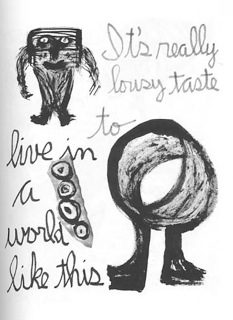
I am not sure when I first discovered the poet, Kenneth Patchen. Somehow I came across the New Directions paperback of his Collected Poems. (I also came across Kenneth Rexroth around the same time in the same way) I think I was in high school or college at the time.
Patchen is pretty much unknown these days. Poetry circles know about him but you never see any reference to him in print media or even on popular internet sites. I suppose this is the typical fate of most poets in America, especially rebel poets. Patchen has also been dead for a while. He died in 1972.
I wanted to write this blog entry to recognize him and to try, in a very small way, to rescue his poetry from oblivion. His poetry is passionate, creative, angry, and romantic.
He once described himself this way: “I speak for a generation born in one war and doomed to die in another.” Just to give a little background, Patchen was born in Niles, Ohio on December 13, 1911. His father was a steelworker. Patchen and his wife Miriam lived on both coasts, settling in California. He suffered some awful adversities during the course of his life including the death of his younger sister, a back impairment that caused him severe pain and continuing financial struggles. In the early 50’s, a group of poets including E.E. Cummings, T.S. Eliot, and William Carlos Williams raised money to finance a back surgery for Patchen. His back was never right and for much of the last part of his life, he wrote from bed.
Patchen preceded the Beat Generation and was not a part of that although he did inspire some beats. It seems reductionist to call Patchen a political poet. Besides what could be categorized as his political poems, he wrote tender love poems; he painted poems that merged drawing and poetry; and he combined poetry reading and jazz. He read with Charles Mingus playing. He was ferociously anti-war. His pacifism runs through many poems. He hated fascism and Stalinism. In his poem, “The Executions in Moscow” , he quotes Ignazio Silone. I think this statement is a good reflection of Patchen’s politics.
“I am convinced – and this is the conviction that I have tried to express in all my writings – that to arm ourselves against Fascism we do not need material means above all. To oppose Fascism, we need neither heavy armaments nor bureaucratic apparatuses. What we need above all is a different way of looking at life and at human beings. My dear friends, without this different way of looking at life and at human beings, we shall ourselves become Fascists. And I refuse to be a Fascist – even a Red Fascist.”
I did want to particularly mention Patchen’s painting poems. Some are weird. Some are cosmic. Some defy understanding. They are very imaginative. The one I have included above was a relatively tame one.
I also wanted to mention some of his “Sayings” which are reminiscent of William Blake. Here are a sampling:
“No man’s life is beautiful except in hurtless work.”
“The autumn leaf is emblazoned with spring’s belief.”
” “The real truth of the matter” is usually a lie all slicked up to do a spot of their particularly dirty work.”
“Yes they’ve dirtied the tree, and dirtied the earth around it, but somehow I feel they won’t succeed in keeping much more than the record of their own lack of spirit and humility tethered here.”
“In the love of a man and a woman is the look of God looking.”
Patchen wrote many books. I would suggest his Collected Poems is a great place to start if you are inclined to read more of his poetry. Below are a few Patchen poems I like:
The Character of Love Seen as a Search for the Lost
You, the woman; I, the man; this, the world:
And each is the work of all.
There is the muffled step in the snow; the stranger;
The crippled wren; the nun; the dancer; the Jesus-wing
Over the walkers in the village; and there are
Many beautiful arms about us and the things we know.
See how those stars tramp over heaven on their sticks
Of ancient light: with what simplicity that blue
Takes eternity into the quiet cave of God, where Caesar
And Socrates, like primitive paintings on a wall,
Look, with idiot eyes, on the world where we two are.
You, the sought for; I, the seeker; this, the search:
And each is the mission of all.
For greatness is only the drayhorse that coaxes
The built cart out; and where we go is reason.
But genius is an enormous littleness, a trickling
Of heart that covers alike the hare and the hunter.
How smoothly, like the sleep of a flower, love,
The grassy wind moves over night’s tense meadow:
See how the great wooden eyes of the forest
Stare upon the architecture of our innocence.
You, the village; I, the stranger; this, the road:
And each is the work of all.
Then, not that man do more, or stop pity; but that he be
Wider in living; that all his cities fly a clean flag…
We have been alone too long, love; it is terribly late
For the pierced feet on the water and we must not die now.
Have you wondered why all the windows in heaven were broken? Have you seen the homeless in the open grave of God’s hand?
Do you want to acquaint the larks with the fatuous music of war?
There is the muffled step in the snow; the stranger;
The crippled wren; the nun; the dancer; the Jesus-wing
Over the walkers in the village; and there are
Many desperate arms about us and the things we know.
“The Way Men Live Is A Lie”
The way men live is a lie.
I say that I get so goddamned sick
Of all these pigs rooting at each other’s asses
To get a bloodstained dollar – Why don’t
You stop this senseless horror! this meaningless
Butchery of one another! Why don’t you at least
Wash your hands of it!
There is only one truth in the world:
Until we learn to love our neighbor,
There will be no life for anyone.
The man who says, “I don’t believe in war,
But after all somebody must protect us” –
Is obviously a fool – and a liar.
Is this so hard to understand!
That who supports murder, is a murderer?
That who destroys his fellow, destroys himself?
Force cannot be overthrown by force;
To hate any man is to despair of every man;
Evil breeds evil – the rest is a lie!
There is only one power that can save the world –
And that is the power of our love for all men everywhere.
A Time to Believe!
O “fruitful and purified” – an identity in the Invisible! Nothing is ever contradicted, all remains always , unchanged and unchang- ing. Instruction never saves, it lifts but what it lifts is itself.
Ambition is the weakness of all great spirits who in acceptance wil find the joy and the despair they seek. The physician can only cure when he is willing to assume your disease. To be
shunned is to be God a little –
We cannot add to what we are, nor can we take away. The
world is One Thing.
What sort of theory can any man draw up for the human spirit! We don’t need theories – we need Love, Humility, Simplicity – new ways to give! The brightest boys have all sold out. They can’t get anyone to believe them because the only “truth” they spout is one that won’t offend. But I am exaggerating – they are quite willing not only to offend but to murder anybody their “governments” will tell them to. With all proper respect for metric nicety, let it be said. These disgusting little lice! These betrayers of Life!
Everywhere the same – the same lousy sellout! The whole kit and caboodle of them! The vicious, stupid fools! Lackies of madmen bent on butchering the world!
But I tell you that Life will be avenged
I tell you that Life will look after its own
I tell you that Life will allow nothing to be added or taken away
Aye, now is the time to believe
When there is nothing to believe in!
Aye, now is the time to believe
if it does no more than show we’re still alive!
So let us present our duties with some humility as it gets dark now. In case it all does end, the crime will not be of our doing. For I’d rather take a nothing I loved to my grave than a something I have every reason to hate.
Lawmakers Have Done Grievous Harm To Courts – published in the Concord Monitor 1/6/2013
With a new Legislature coming to Concord, it is a good time to review how recent New Hampshire legislatures have treated the judicial branch. The truth is not pretty. Going back to the judicial impeachment trials and anger at the Claremont school decision, I would say the dominant legislative attitude has been hostility, expressed by under-funding.
Instead of being seen as a respected co-equal branch of government entitled to adequate funding, the judicial branch has been reduced to being a beggar for funds, competing and standing in line with other state agencies.
Maybe it shouldn’t need to be said, but the judicial branch is a branch of government just like the executive and the legislative. It is not a state agency like Fish and Game or Health and Human Services. In his talk in Concord last September, Justice David Souter remarked on the fact that two-thirds of Americans do not understand we have three branches of government. I wonder if some of the two-thirds were in our Legislature. The skinflint approach of our last Legislature was not just harmful to court functioning, it was self-destructive to government.
I will focus on three consequences of the under-funding that have damaged the justice system. There are others.
First, under-funding the courts has translated into understaffing the court system. Attorney Lee Nyquist outlined the results in a recent piece in New Hampshire Business Review. Delay is the major cost to citizens. Litigants, especially in our new circuit courts, which have jurisdiction of domestic matters, must wait longer for hearings. Nyquist says it takes six months to get an initial temporary hearing after a divorce is filed; six months for a hearing on a divorce modification and four months for a hearing on an emergency domestic matter like parental visitation.
It also takes longer to get written decisions from the court. There are too few clerical staff handling too many cases. As Nyquist says, this is not the fault of hardworking court staff. Because of the understaffing, he says that litigants may have to wait two months before a decision is sent out by the clerk’s office. For the litigants, especially in family matters, the delay often adds stress, anxiety, and sometimes financial hardship.I spoke to two New Hamp-
shire attorneys to get their take. Mary Krueger, director of the New Hampshire Legal Assistance Domestic Violence Advocacy Project, pointed to courts’ reluctance to issue orders on child support in the context of domestic violence cases. Judges are so crunched they will defer to the court issuing a divorce or parenting order. Unfortunately, the delay in making an order can be very detrimental to the litigant who may be desperately in need of income.
Steve Cherry, a Henniker attorney, mentioned the 2011 legislative action de-funding guardians ad litem (GALs) as harmful to low-income clients. For over 30 years, GALs have contributed to quality resolution of very difficult domestic disputes. They have acted as the eyes and ears of the court in assessing the best interest of children. While capable of error like anyone else, GALs often offer the court a very helpful perspective and insight. This legislative de-funding particularly hurts the poor who lack income to pay for a GAL. Financially better-off folks did not lose out since they can afford to pay if they need a GAL.
Legal Assistance cut
The second damaging consequence of legislative underfunding was the $1 million cut to New Hampshire Legal Assistance, a non-profit law firm that advocates for the poor, elderly and disabled. The cut led to the closing of both the Nashua and Littleton legal aid offices. The organization had to shrink dramatically and lay off dedicated, long-time, highly trained staff. The cut meant thousands fewer clients could be served.
Those unfamiliar with legal aid probably do not appreciate the gravity of the cut. Legal Assistance advocates have had an unsurpassed ability to get outstanding results for their clients in very challenging circumstances. Without an advocate, the likelihood of a poor outcome sharply increases. The cut meant more vulnerable clients getting evicted, foreclosed on, and facing benefit denials without help. These everyday adverse events are business as usual, under any radar screen. The underside of the lives of poor people generally escapes scrutiny.
There was a double indignity in the Legal Assistance cut. Lawyers who work for Legal Assistance make an idealistic commitment to the public interest. While they develop expertise in poverty law, they earn quite a bit less than they could earn in private practice. Instead of recognizing and honoring that commitment, the Legislature coldly trashed it. There was a willful blindness to the damage inflicted. Not only was Legal Assistance devalued, it was undermined.
I find it grating when spokespeople from the last Legislature tout its budget-cutting and all the money saved. It is only fair to point out the unacknowledged harm which consistently falls on the poor and people not represented by expensive lobbyists.
Abuse, neglect cases
The third area of under-funding I want to mention was the 2011 legislative stripping of the right to a lawyer in abuse and neglect cases. Indigent parents previously had the right to a lawyer when they faced charges of abuse or neglect.
The last Legislature removed the statutory requirement that parents get lawyers in these cases. New Hampshire had the dubious distinction of joining Mississippi as one of the only two states to deny counsel to poor people in these cases.
It is hard to overstate this particular harm. How many rights are more fundamental than the right to raise and care for your children? Parents facing abuse or neglect charges need counsel. They may be illiterate, poorly educated, of limited English proficiency, homeless or mentally ill. They may be incapable of articulating a defense they have. Sometimes poverty itself can be seen as neglect. There is something wrong and shameful when such a fundamental right is sacrificed solely for economic reasons.
It is possible to see the matters I have discussed as random and not reflecting a larger whole. However, I think not. There has been a pattern of punishing the justice system, especially poor litigants who are people with the least clout to fight back.
I hope the new Legislature turns over a new leaf and is ready to move beyond the past. When legislators under-fund the judicial branch, the truth is that they are only shooting themselves in the foot.
(Jonathan P. Baird of Wilmot is a federal administrative law judge who previously worked as an attorney for New Hampshire Legal Assistance. This column reflects his views, not those of his employer, the Social Security Administration.
Some Poems in Honor of my Mother posted 12/27/2012
> This December marks two year since my mom, Deena Baird, passed away. I think about her passing often , and I wonder why it happened when it did. Some things do not add up to me. My mom was quite a spirited woman although she was prone to depression. I miss her presence, her grace, her kindness, and her sensibility. She was dark but funny. I wanted to remember her on this occasion. Here are several poems I have chosen in her honor. Jon >
> Her Kind by Anne Sexton
>
> I have gone out, a possessed witch,
> haunting the black air, braver at night;
> dreaming evil, I have done my hitch
> over the plain houses, light by light:
> lonely thing, twelve-fingered, out of mind.
> A woman like that is not a woman, quite.
> I have been her kind.
>
> I have found the warm caves in the woods,
> filled them with skillets, carvings, shelves,
> closets, silks, innumerable goods;
> fixed the suppers for the worms and the elves:
> whining, rearranging the disaligned.
> A woman like that is misunderstood.
> I have been her kind.
>
> I have ridden in your cart, driver,
> waved my nude arms at villages going by,
> learning the last bright routes, survivor
> where your flames still bite my thigh
> and my ribs crack where your wheels wind.
> A woman like that is not ashamed to die.
> I have been her kind.
>
>
> As I Walked Out One Evening by W.H. Auden
>
>
> As I walked out one evening,
> Walking down Bristol Street,
> The crowds upon the pavement
> Were fields of harvest wheat.
>
> And down by the brimming river
> I heard a lover sing
> Under an arch of the railway:
> “Love has no ending.
>
> “I’ll love you, dear, I’ll love you
> Till China and Africa meet,
> And the river jumps over the mountain
> And the salmon sing in the street,
>
> “I’ll love you till the ocean
> Is folded and hung up to dry
> And the seven stars go squawking
> like geese about the sky.
>
> “The years shall run like rabbits,
> For in my arms I hold
> The Flower of the Ages,
> And the first love of the world.”
>
> But all the clocks in the city
> Began to whirr and chime:
> “O let not Time deceive you,
> You cannot conquer Time.
>
> “In the burrows of the Nightmare
> Where Justice naked is,
> Time watches from the shadow
> And coughs when you would kiss.
>
> “In headaches and in worry
> Vaguely life leaks away,
> And Time will have his fancy
> Tomorrow or today.
>
> “Into many a green valley
> Drifts the appalling snow;
> Time breaks the threaded dances
> And the diver’s brilliant bow.
>
> “O plunge your hands in water,
> Plunge them in up to the wrist;
> Stare, stare in the basin
> And wonder what you’ve missed.
>
> “The glacier knocks in the cupboard,
> The desert sighs in the bed,
> And the crack in the teacup opens
> a lane to the land of the dead.
>
> “Where the beggars raffle the banknotes
> And the Giant is enchanting to Jack,
> And the Lily-white Boy is a Roarer,
> And Jill goes down on her back.
>
> “O look, look in the mirror,
> O look in your distress;
> Life remains a blessing
> Although you cannot bless.
>
> “O stand, stand at the window
> As the tears scald and start;
> You shall love your crooked neighbour
> With your crooked heart.”
>
> It was late, late in the evening,
> The lovers they were gone;
> The clocks had ceased their chiming,
> And the deep river ran on.
>
>
>
> The Seventh by Attila Jozsef
>
> If you set out in this world,
> better be born seven times.
> Once, in a house on fire,
> once, in a freezing flood,
> once, in a wild madhouse,
> once, in a field of ripe wheat,
> once, in an empty cloister,
> and once among pigs in a sty.
> Six babes crying, not enough:
> you yourself must be the seventh.
>
> When you must fight to survive,
> let your enemy see seven.
> One, away from work on Sunday,
> one, starting his work on Monday,
> one, who teaches without payment,
> one, who learned to swim by drowning,
> one, who is the seed of a forest,
> and one, whom wild forefathers protect,
> but all their tricks are not enough:
> you yourself must be the seventh.
>
> If you want to find a woman,
> let seven men go for her.
> One, who gives his heart for words,
> one, who takes care of himself,
> one, who claims to be a dreamer,
> one, who through her skirt can feel her,
> one, who knows the hooks and snaps,
> one, who steps upon her scarf:
> let them buzz like flies around her.
> You yourself must be the seventh.
>
> If you write and can afford it,
> let seven men write your poem.
> One, who builds a marble village,
> one, who was born in his sleep,
> one who charts the sky and knows it,
> one, whom words call by his name,
> one, who perfected his soul,
> one, who dissects living rats.
> Two are brave and four are wise;
> you yourself must be the seventh.
>
> And if all went as was written,
> you will die for seven men.
> One, who is rocked and suckled,
> one, who grabs a hard young breast,
> one, who throws down empty dishes,
> one, who helps the poor to win,
> one, who works till he goes to pieces,
> one, who just stares at the moon.
> The world will be your tombstone:
> you yourself must be the seventh.
>
>
> Translated from the Hungarian by John Balki
>
>
>
>
>
Poor People and the Mean Machine – published in the Concord Monitor 9/16/2012, posted 12/25/2012
I was never previously able to post this piece I wrote for the Concord Monitor. It appeared on September 16, 2012. Jon
The subject of poverty is not part of our national conversation in 2012. The presidential and vice-presidential candidates barely ever talk about it. Nor do the Senate or congressional candidates. That is remarkable, since poverty has increased significantly over the past 12 years.
When was the last time any major politician directly proposed to end or lessen poverty? We probably have to go back to President Lyndon Johnson. While President Obama’s stimulus did many positive things for poor people, he chose not to publicize that. It is almost as if poverty is taboo.
In New Hampshire, poor people are close to being an invisible constituency, even as they increase in number. I lived in Alaska for 15 months in 2010 and 2011, reading the Monitor online and watching from afar. I was astounded at the hostility directed against New Hampshire’s poor by our Legislature.
If there was a word I would use to describe our Legislature’s actions, it would be “mean-spirited.” The Legislature became a bludgeoning Mean Machine. Across the board, it savaged programs for the blind and disabled, youth, seniors, and the poor with an almost cavalier disregard for the damage inflicted.
There was no appreciation of the concept of the safety net. While the right-wing extremists in the Legislature appeared to care little, it must be pointed out that historically the safety net has been a bi-partisan, uniquely American achievement. It has taken 80 years to create the protections we have, although that was not appreciated by the legislative majority.
Surprising as it was to admit, later in 2011 when i returned east, Alaska, a politically conservative state, looked positively moderate next to New Hampshire. Our Legislature acted with the social vision of a Mississippi or Alabama.
How could the Legislature be so mean-spirited? I think part of the answer lies in a right-wing ideology that blames the poor for poverty and especially hates welfare. The stereotype that somewhere moochers, scammers, and lazy bums are getting something for nothing resonates with them and others. How else to explain the plethora of bills last session directed at limiting welfare or investigating it like it was a crime? Let’s see: There was the welfare time-limit bill, the no benefit increase if you have a baby on welfare bill, the drug-testing if you are on food stamps bill, the counting SSI if you are on welfare bill and the computer match welfare fraud bill. They set an agenda and I am not naming all of them.
The irony is that welfare in the form of cash-assistance programs like Temporary Assistance for Needy Families has drastically declined. Since the 1960’s, a much smaller percentage of poor families with children actually get these benefits. That is true in every state in the nation.
I do not think that debates about poverty have kept up with actual societal changes. Conservatives and liberals are stuck in old patterns of replaying the same unenlightening fights they have had for 20 years. Here are some points about how poverty is different now:
- The Great Recession has created many more poor people.
Many formerly middle-income people have dropped into the ranks of the poor. Due to layoffs and job outsourcing, millions more Americans find themselves jobless and in need. While New Hampshire’s poverty rate remains below the national rate, the stimulus in the form of extended unemployment benefits played a critical role in preventing more poverty. Of particular note, an increasing number of the poor are in extreme poverty, living below half the poverty level. I am talking about people earning less than $9,000 a year for a family of three. In 2010, more than 20 million Americans lived in extreme poverty. That figure is up 8 million over 10 years. For many of these people, their only benefit or help is typically food stamps. We remain in a state of denial about the existence of this population, with no public policy response.
- Good-paying, low-skill jobs have disappeared.
Job loss in the recession has been the most severe of any recession since World War II. Over the past 40 years, where jobs have been created, the big story is the increase in low-wage jobs. Instead of jobs that pay a living wage and provide benefits, half the jobs in America now pay less than $34,000 a year and almost a quarter pay below the poverty line for a family of four ($22,000 per year). The trend applies in New Hampshire as in other states. Earning that kind of money makes our era a period of limited upward mobility. Simple financial survival is more the agenda than getting ahead.
- The super-rich have become astronomically richer.
The other side of the poor getting poorer is the rich getting richer. We live in a second Gilded Age, with a new set of robber barons. Rich has a new meaning now. I do not think there is public awareness of how wealthy the 1 per cent are.
Between 1979 and 2007, the income of the top 1 per-cent went up 275%, while the income of the top 0.1 per-cent increased 390%. And those statistics do not include the past five years, where the trends I mention have accelerated. It is not class warfare to bring this up – it is simply factual.
- The social safety net has been weakened
By any objective measure, we have withdrawn support from the social programs that comprise the safety net. There is less help at a time with more human need. The best example I can think of is what the New Hampshire Legislature did to New Hampshire Legal Assistance. Without any justification, the Legislature inflicted a devastating blow against Legal Assistance, cutting critically needed funding by $1 million. The funding cut meant closure of legal aid offices in Nashua and Littleton as well as many layoffs. A program that had 53 employees in 2008 was downsized to under 30 in 2012. The result was thousands fewer vulnerable citizens getting legal services. In the interest of full disclosure, I want to note that I used to be a legal aid lawyer. I know better than most the meaning of these cuts: more hunger, more homelessness, more human misery for the poor.
Nationally, proposals to block grant Medicaid, voucherize Medicare, and further cut all poor people’s programs wait in the wings. The major program still reaching masses of people is food stamps. You really need a black sense of humor to appreciate what has happened to welfare. Public debate focuses on a phony issue about work requirements while the overriding salient fact is how few people get these benefits. Nobody talks about that.
When people last talked about poverty as a public policy issue back in the 60’s, it was in the context of “the war on poverty”. I think that is a bad metaphor. It is not like there have been epic battles where two sides fought it out with one side victorious. The war on poverty typically involves incremental gains or losses in individual lives. A hungry mother and child get food stamps so they can eat; a family gets help from a legal aid lawyer so they can avoid eviction; a laid-off worker wins her unemployment appeal. These are the type of small stories that comprise the so-called war on poverty.
President Ronald Reagan once famously said, “We fought a war on poverty and poverty won.” Reagan got it dead wrong. Contrary to the mythology that government did not help. efforts to tackle poverty have made an enormous difference.
I like the way Georgetown Law professor Peter Edelman responded to President Reagan’s line in his new book “So Rich, So Poor”. Edelman wrote:
“To suggest dismissively – as many conservatives do – that “we fought a war on poverty and poverty won” simply because there is still poverty is like saying the Clean Air and Clean Water Act failed because there is still pollution.”
Gains made by anti-poverty activists may be temporary and they do not guarantee a permanent result, but they are often a critical ingredient in averting potential disaster. Efforts to dismantle or gut the safety net deserve strict scrutiny, especially given the level of need out there. There is an extensive body of experience showing that the free market, left to its own devices, fails to address poverty.
A great country should have worthy, inspirational goals. Ending or lessening poverty would be a noble goal. We certainly have the wealth to accomplish it. I think it is bad for America that we do not talk about ending poverty. I think that idea should be put back on our collective agenda.
Founders Were Passionate About Science – published in the Concord Monitor 4/19/09 – posted 12/21/2012
I wrote this piece back in 2009. When I moved my blog site, I was not able to post it so I wanted to put it up now. Jon
When President Obama recently signed a memorandum designed to restore scientific integrity to federal government decision-making, I felt both pride and relief. Obama resurrected a fundamental American value: respect for science and intellectual integrity.
The Bush presidency featured an infamous war on science in which partisan policy goals played a key role in determining scientific results. Whether the issue was evolution, abstinence, embryonic stem cell research or global climate change, the value of deference to religious conservatives and Big Business allies trumped scientific integrity.
What has not been appreciated about the war on science is how antithetical it is to American tradition. Passion for science was part of the world view of the founding fathers. Some founders even were scientists.
Historically, the Bush presidency was an extreme aberration. While earlier presidents like Ronald Reagan had an anti-scientific bent, that science abuse did not rival George W. Bush’s.
Over the past eight years, the methods of science abuse included magnifying uncertainty of proven theories, creating contrary science, and presenting fundamentally religious beliefs as science.
The best example is evolution. There has been a continuing effort by creationists to thwart the teaching of evolution in public schools. As recently as last week, this fight was happening in Texas.
This is 84 years after the Scopes monkey trial, when a high school teacher was tried for teaching that humans evolved from a lower order of animals. Yet the Religious Right keeps coming back. They have been building biblical creation science museums to popularize intelligent design, the latest version of creationism.
Bush favored teaching intelligent design alongside evolution. In this, he was no different than many of his colleagues, including House Speaker John Boehner, Alaska Gov. Sarah Palin and Louisiana Gov. Bobby Jindal.
The creationists have framed the evolution argument as a free speech fight. There are two competing theories, evolution and creationism. Both can be taught in public school, and students can decide what to believe. They only want to teach the controversy.
What the creationists do not say is that among scientists, there is no controversy. Evolution is widely accepted as a fact. In 2002, the American Association for the Advancement of Science issued a resolution stating that intelligent design proponents failed to offer credible scientific evidence to support their theory.
How do you test the theory that an unknown intelligent designer somehow did something somewhere to create life on earth?
In his new book “Why Evolution is True”, evolutionary biologist Jerry Coyne lays out the main lines of evidence for evolution. He explains how life evolved gradually, beginning with one primitive species that lived 3.5 billion years ago. He explores how species branched out, throwing off many new and diverse variations. He demonstrates that the mechanism for most evolutionary change has been natural selection.
Yet, despite the evidence, polls consistently show Americans are suspicious about evolution. In a 2006 poll, when asked to respond to the statement “Human beings, as we know them, developed from earlier species of animals,” only 40% of Americans judged that statement true. More than 80% of French, Scandinavians, and Icelanders accepted the statement as true.
It is particularly ironic that antievolutionists have established such strong support here. As Enlightenment thinkers, the founding fathers would have been appalled by this development. There is much evidence that they believed science to be a supreme expression of human reason.
Among the founders, Benjamin Franklin was recognized as one of the foremost scientists of his day. While he was best known for his experiments with electricity, he had wide-ranging scientific interests including meteorology and oceanography.
Thomas Jefferson was also a man of science, an inventor, an architect, and a passionate botanist. When Jefferson was inaugurated as vice president in 1797, he brought with him a collection of fossils to illustrate a lecture on paleontology he was to give to a scientific society. Through his presidency, he maintained this interest, filling the East Room with a huge fossil collection.
It was no accident that our Constitution explicitly references science. There is a provision setting forth the power of Congress “to promote the Progress of Science and Useful Arts.”
Good public policy depends on rationality and clear thinking. Basing public policy on religious imperatives or covert subordination to business interests is a return to the Dark Ages. I suspect the founding fathers would have agreed.
Way To Go , Wilt originally published in the Concord Monitor 6/24/2012 12/15/2012
I will be posting a few articles I was not able to post previously when my blog was down earlier this year. This one I wrote last summer. 2012 marks the 50th anniversary of Chamberlain’s 100-point game. Jon
The NBA playoffs this year were exciting. Although I am a Philly sports fan, after the Sixers went down, I found myself rooting for the Celtics. It was a visceral, emotional thing. I liked the old guys playing together so well, pushing the Heat to the limit and almost winning. Except for that last fourth quarter, the Celts were the Heat’s equal. It was a noble effort.
Watching stirred up some basketball memories for me. When I think of players who played hard and gave all, I think of Wilt Chamberlain, who died in 1999. Wilt, known as “Wilt the Stilt” and “The Big Dipper” was a transformative player, a giant on the court and a fierce competitor. Wilt was 7-foot-1. There were not nearly as many big men playing then, back in the early 1960’s. When he started, Wilt was one of three 7-footers in the NBA.
It is impossible not to think of Wilt’s rivalry with the Celtics’ equally great Bill Russell. There has never been a better basketball match-up. Among Wilt’s accomplishments, he pretty much invented the dunk shot. It was his signature shot and it had its own name – Dipper Dunk. Wilt developed an array of shots. As a finely coordinated athlete, he crafted the finger roll, a hook shot and a fade away bank shot. He was also a great rebounder, and he was no slouch with assists. The NBA changed its rules around goaltending because of Wilt. It also widened the foul line from 6 to 12 feet to eliminate Wilt’s advantage in rebounding and scoring on missed shots.
This year is the 50th anniversary of when Wilt scored 100 points in a game. It is a record that still stands. I was listening to the game that night on my trusty transistor radio from my home in Lower Merion, Pa., just outside Philadelphia, where I grew up. It was March 2, 1962. The Wilt-led Philadelphia Warriors were playing the last place New York Knicks in Hershey, Pa.
Back in the day, the NBA scheduled occasional games in small towns like Hershey to try to drum up interest in basketball. Games were often not recorded or televised. There was no ESPN, no Sports Center and no instant electronic documentation of everything. There were no TV cameras at the game that night, and there is no video of Wilt’s feat. There were hardly any sports writers at Hershey Arena. Tickets cost $2.50. Attendance was 4,124 that night.
Bill Campbell, a well known Philly sportscaster of the era, called the game for WCAU-AM radio. I remember I used to snooker my parents who thought I was upstairs doing homework. I would close the door to my bedroom, plug in earphones and listen. Sometimes I would listen to away games late at night under the covers long after everyone in my family had gone to bed. Among other sports memories, I remember listening when the Phillies lost to the Dodgers in L.A. as they blew the National League pennant during their infamous 1964 slide.
On March 2, 1962, Wilt was coming off a game in which he had scored 61 points. He started with 23 points in the first quarter. He had 41 at half-time. It really wasn’t until the third quarter that people knew something special was up. Wilt had scored 69 after three quarters and 75 with eight and a half minutes left in the game. By that time, the crowd was screaming, “Give it to Wilt!” Dave Zinkoff, the Warriors public address guy, announced Wilt’s tally after each basket.
While he actually missed 27 out of 63 shots from the floor that night, Wilt was in a zone. He went 9 for 9 from the free-throw line in the first quarter and 28 of 32 from the free-throw line during the whole game. That was highly unusual. Wilt was a notoriously bad free-throw shooter, usually shooting around 50 percent.
When the Knicks realized Wilt might reach 100, they did everything they could to stop him. They waited until the 24-second shot clock was about to expire before they shot. They fouled all the Warriors except Wilt. At the same time, the Warriors kept feeding Wilt the ball.
In the fourth quarter, Bill Campbell told listeners, “If you know anybody not listening, call them up. A little history you are sitting in on tonight.” When Wilt scored his last basket with a minute left in the game, the crowd went wild. Spectators mobbed the floor and the game was stopped for some time. There was a picture taken with Wilt holding the number 100.
Wilt was a larger than life character. My dad knew Eddie Gottlieb, the Warriors owner, and he arranged for me to meet Wilt after a game. I remember shaking Wilt’s hand and looking up. I came up to his waist. It was a great moment for a kid.
Kobe Bryant, who is also from Lower Merion, tells a story of meeting Wilt when he was a little boy. Kobe’s father Joe said “Kobe, I want to introduce you to somebody. He’s one of the greatest players of all time”. Kobe looked at Wilt and said “Bombaata”. Bombaata was a character from Conan the Destroyer. Apparently Wilt took no offense.
Supposedly the night before the 100-point game, Wilt was in New York City visiting a lady friend. At 6am, he dropped her off at home. He later said that he had not slept a wink and he had a hangover. He boarded the 8am train to Philadelphia. He was worried he was not going to make it on time to catch the team bus to Hershey. He made it. Back in those days, teams did not necessarily go to a hotel before a game if they were travelling.
The Warriors got to Hershey hours early. Because he had time to kill, Wilt went to the Hershey Arcade. He claimed he set pinball records that afternoon. He won a lot of prizes. He was hot.
In writing about Wilt, I did want to put to rest one off-the-court myth. In his autobiography, Wilt floated the ridiculous assertion he slept with 20,000 women. Wilt no doubt pushed that myth to sell books. Without getting into mathematical calculations, I would assert that Wilt was indulging the male bravado game. A former L.A. reporter Doug Krikorian, who covered the Lakers during Wilt’s time there and who was a close personal friend of Wilt’s, wrote the following:
“Complete hyperbole. Trust me. I spent many a Saturday night where Wilt would call me and say “Let’s go out and have dinner together”. He was the worst guy I’ve ever seen trying to hustle women, I’m serious. That thing should be debunked. Trust me. I saw first hand. Yes, he might have had his share of women, but as a slick hustler, please. No. I saw too many nights where he was alone. I was with him.”
Krikorian, a credible source, said Wilt felt regret for his stupid boast. He felt it took attention away from what he accomplished on the court.
A few years ago, I was at a Border’s outside Philadelphia and I ran into Wilt’s former coach from Overbrook High School, Cecil Mortensen. He was at a table selling his book about Wilt. I chatted him up, and he did have some good Wilt stories. In his book “It All Began With Wilt”, he wrote, “People have always asked me what kind of a person was Wilt. My answer is always the same. He had real character. There was a lot of delinquency around Overbrook at that time, but he was always above it. He came from a really good home life and it showed. He was a good student also. Most of his grades were B’s and what he got, he earned.”
Mortensen told one other story I liked: Overbrook was getting ready to play Frankfort High. Warm-ups were going on and Mortensen was talking to the opposing coach. He looked over at his bench. Wilt was adorned with a golf cap. a shimmering white silk scarf and dark sunglasses. Mortensen said he looked like a character from Mad Magazine. Wilt was an original.
 Jonathan P. Baird